
Case Study 2 – Early Access Program
A sponsor company running a suite of early access programs discovered critical gaps in oversight, safety reporting, and HCP accountability — prompting a structured audit-led intervention.
Problem Statement
A sponsor company has implemented a suite of early access programs. Upon investigation, due to internally raised concerns, it was decided that there was little information available to the sponsor regarding the activities associated with these programs. A handful of safety cases had been received. Health care provider (HCP) oversight of patients receiving the drug products was limited or missing.
Discussions were hampered by an absence of guidance regarding what should be expected from contract companies and HCPs involved. Key questions regarding informed consent, safety reporting, drug product management and the management of project records could not be answered.
Solution
In this case it was decided that a well planned audit should be utilised to identify potential gaps. An initial consultation was held, to include the sponsor and third party contract companies. Contracts were reviewed, controlled documents checked and responsibilities mapped. An audit scope was developed and agreed with the audit team, sponsor and third party contract companies.
Contracts were determined to be essential in this case. As the early access programs involved a HCP attestation to follow project requirements — without a requirement to report on progress — the contracts proved to be a useful tool in driving accountability.
The audit included an assessment of areas not previously considered, including pharmacovigilance, drug product management and more. Auditors were careful not to go out of scope and certain areas were deemed to be entrusted to HCPs and covered by the attestation signed.
The audit tested some assumptions, which were found to be flawed. For example, the assumption that HCPs were in receipt of all the correct instructions, most recent protocols or informed consent forms. It was also identified that there was no evidence that HCPs were actually able to report adverse drug reactions, or that they were aware of the need to do so.
Key Outcomes
Key outcomes included the development of formal processes, implemented through controlled documents and training:
- Implementation of the testing of safety case reporting mechanisms.
- Implementation of a drug recall test.
- Implementation of traceability of HCP receipt of project instructions.
- Implementation of HCP credential checks.
- Implementation of key performance indicators at the third party vendor level.
- Documentation of HCP project training.
Ready to strengthen your compliance?
Talk to 360 CRC today about how 360 Clinical Research Consultancy can help your organisation achieve and maintain regulatory compliance.
Get in TouchLatest Posts

5 min read
Shane Comiskey, Managing Director of 360 CRC, announces a new Subject Matter Expert partnership with Libertas Software Research, supporting the development of ORDU Studio, LSR's modular multi-agency incident management platform.
12 min read
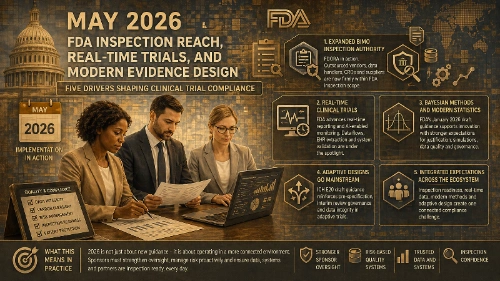
Welcome to the May 2026 edition of the 360 Clinical Research Consultancy Insights! In this issue, FDA Inspection Reach, Real-Time Trials, and Modern Evidence Design.
08 May 2026
Read More →: Insights: May 2026
12 min read
Welcome to the April 2026 edition of the 360 Clinical Research Consultancy Insights! In this issue, The New UK Clinical Trials Regulations Are Live: What April 2026 Changed in Practice
10 Apr 2026
Read More →: Insights: April 2026